
The Rhine Falls near Schaffhausen is the largest waterfall in Europe and an ideal day trip from the Sonnenhof & Sonnhalde wellness hotel. All information on how to get there, boat trips, viewing platforms and admission.
The Rhine Falls are located about a 45-minute drive from the Sonnenhof & Sonnhalde wellness hotel — nestled in an unspectacular landscape directly on the German-Swiss border near Schaffhausen. Anyone expecting Europe's largest waterfall to be set in a mountain panorama is mistaken: it plunges right in the flatlands over a 23-metre-high rock ledge into the Rhine. That is precisely what makes them special.
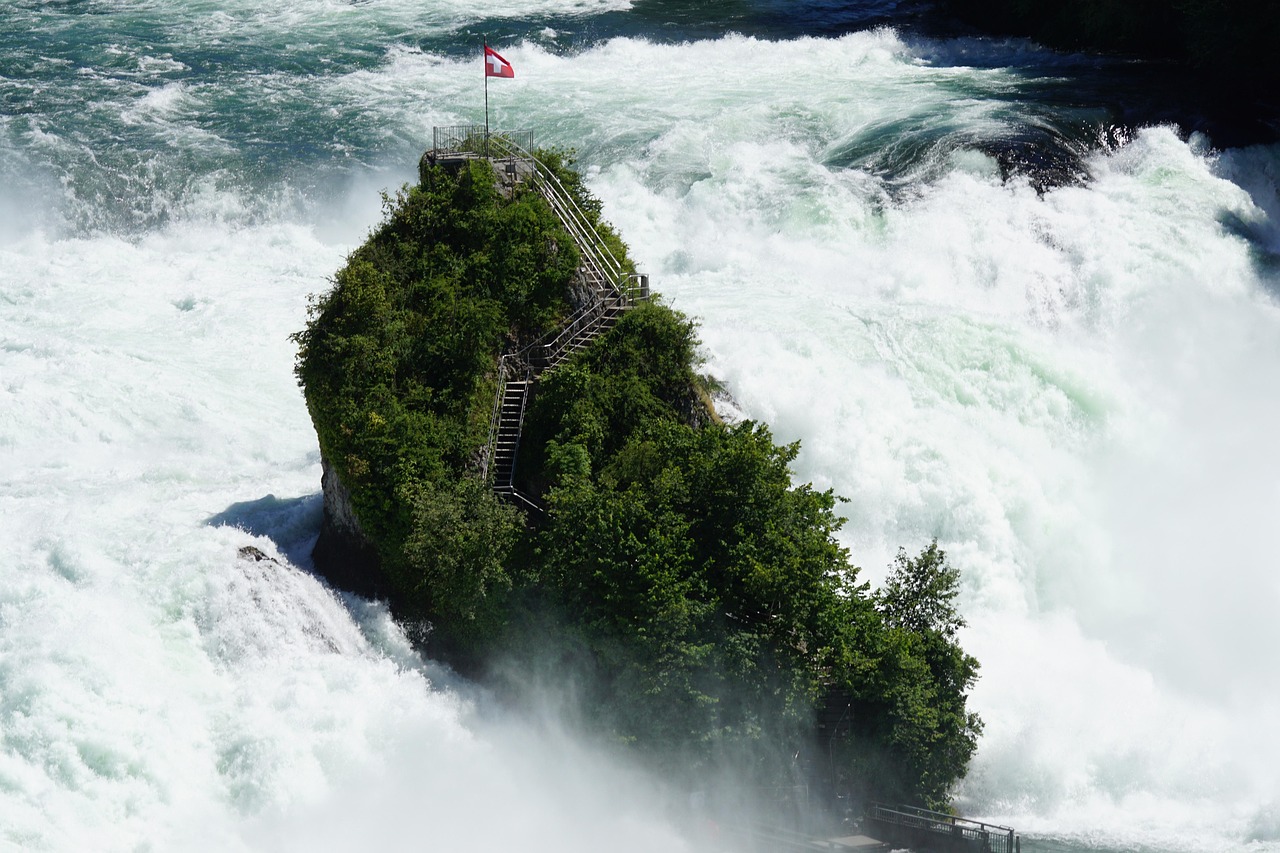
On sunny days, around 600,000 litres of water rush over the rock every second, and significantly more in the spring when the snow melts. Anyone who has ever taken a boat right up to the middle rock knows why this excursion should have a place on every stay in the Black Forest.
Where exactly is the Rhine Falls located?
The Rhine Falls are located on the High Rhine between the Swiss cantons of Schaffhausen (north bank with Wörth Castle) and Zurich (south bank with Laufen Castle). Geographically, they are situated about four kilometres west of the Schaffhausen old town, in the immediate vicinity of the German-Swiss border. The address for satellite navigation systems is: Schloss Laufen, Laufen-Uhwiesen, ZH (south side) or Rheinfallquai, Neuhausen am Rheinfall, SH (north side). It is around a 30-minute drive from Waldshut-Tiengen, and about 45 minutes from the Hotel Sonnenhof & Sonnhalde.
What makes the Rhine Falls special
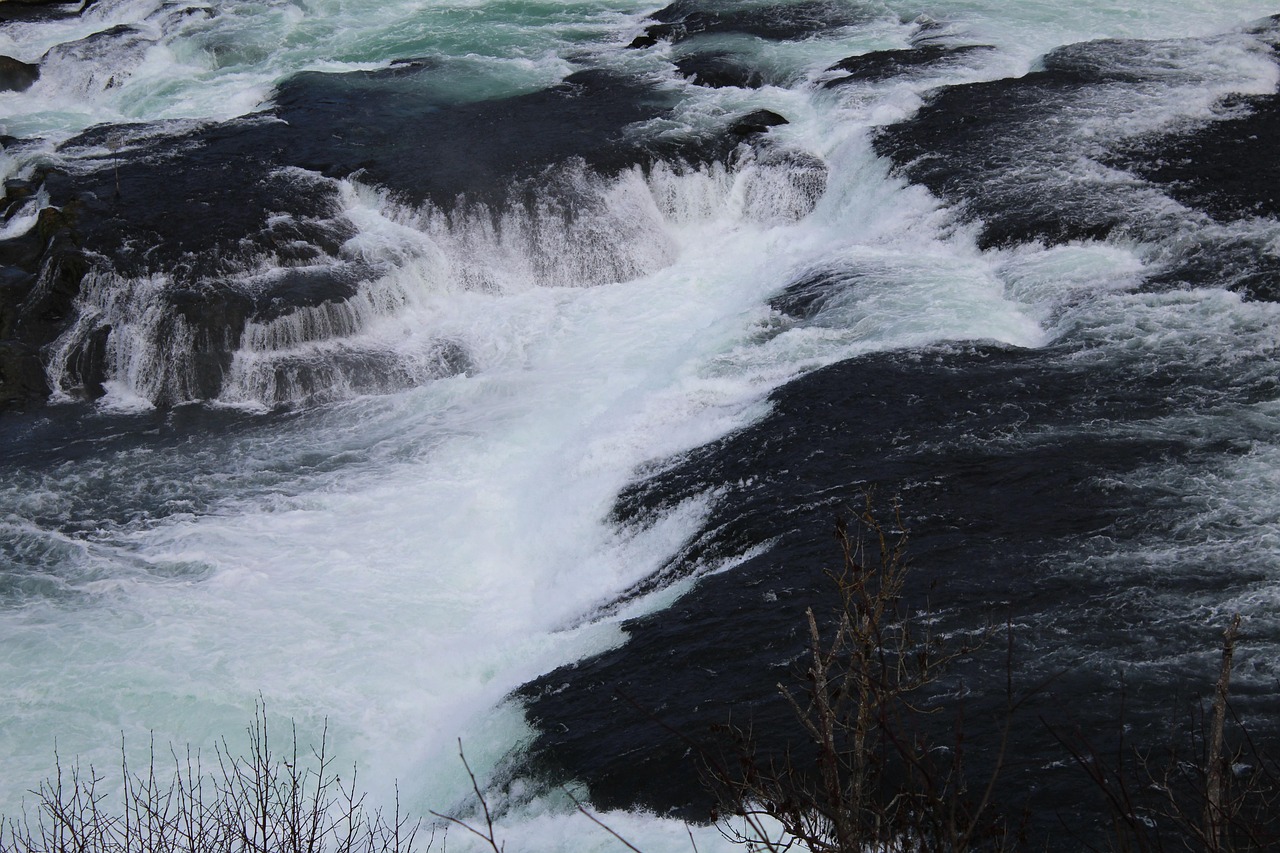
Measuring 150 metres wide, 23 metres high, and with an average flow rate of 373 cubic metres per second, the Rhine Falls is Europe's largest waterfall in terms of water volume. It has retained its present form since the Ice Age and is one of Switzerland's most visited tourist attractions.
Visitors can reach the waterfall from two sides. On the southern side (Neuhausen) is Schloss Laufen with the Belvedere footbridge, which leads directly over the thundering water. On the northern side (Schloss Wörth) the boat trips to the middle rock depart.
The most important viewing platforms
Schloss Laufen with Belvedere Footbridge
The most spectacular view is offered by the Belvedere footbridge below Laufen Castle. You walk along a narrow steel structure almost to the edge of the waterfall where the water plunges over. When there is a lot of water, you will get wet — a rain jacket belongs in the rucksack. Access costs six Swiss francs per adult.
Wörth Castle
On the opposite side, Wörth Castle lies directly on the Rhine. This is where the boat tours depart from, and there is a restaurant and a souvenir shop. The view faces the waterfall head-on — good for family photos.
Middle Rock Tour
The highlight for many visitors: the boat trip to the middle rock, which stands in the middle of the waterfall. A short climb via a rock staircase leads to the platform — from here you look directly at the plunging masses of water. The trip costs 22 Swiss francs and takes around 30 minutes.
Boat trips
Several providers operate boats at the Rhine Falls. The most important tours:
audio tour (around 30 minutes, 11 CHF): once to the waterfall and back. Audio guide in ten languages explains geology and history.
Middle Rock Tour (45 minutes, 22 CHF): Boat trip with ascent to the middle rock. Recommendation for everyone who is here once.
Schloss Laufen TripConnection between Wörth Castle and Laufen Castle — handy if you want to see both sides.
In summer, the boats run every 15 minutes between 9:30 and 18:30. Reservations are not possible.
Which side of the Rhine Falls is nicer?
A frequent question — and the answer is: both have their strengths. The south side with Schloss Laufen and the Belvedere footbridge scores points with its proximity to the waterfall, the dramatic view almost directly onto the edge where the water plunges, and the historic castle backdrop. Here, when the water level is high, you get wet — adrenaline included.
The north side with Wörth Castle offers the classic postcard perspective: the frontal view of the entire waterfall with the central rock and Laufen Castle in the background. This is where the boats depart, and where the restaurant and souvenir shop are located. Families with small children often stay on this side.
Our recommendation: Those who have time should look at both sides — connected by the short boat trip between Wörth Castle and Laufen Castle. Those who can only choose one side can decide according to their preference between drama (South) or overview (North).
Practical tips
Admission. Schloss Laufen costs six CHF (adults) or around six euros. Schloss Wörth is freely accessible, only the boats cost extra.
Directions by car. From Ühlingen-Birkendorf via Waldshut-Tiengen and Schaffhausen — around 45 minutes. Parking is available on both sides for a fee (around five CHF per day). A vignette is required for driving through Switzerland; anyone wanting to travel without a vignette can take the direct route via Jestetten/Lottstetten.
Travel by train. S-Bahn S33 from Waldshut to Schaffhausen, from there bus 1 or 6 to Schloss Laufen. Travel time around 90 minutes.
Best time of day. Early morning (before 10 am) or late afternoon. At midday it is busy, especially on summer weekends.
Footwear and clothing. Sturdy footwear, because the rock stairs at the middle rock are damp. Rain jacket in case of heavy water.
Money. Swiss francs are preferred, euros are mostly accepted (often with an unfavourable exchange rate). Credit cards work everywhere.
Best time of year
May and June are the wettest months — the melting of the alpine snow ensures peak flow rates. In high summer the volume of water decreases slightly, but in return the weather is reliable. In autumn (September to October) the leaves turn vibrant colours and the light is particularly beautiful for photographers. In winter the Rhine Falls are peaceful, the boats run less frequently on a seasonal schedule, and a visit on clear winter days is worthwhile for photography enthusiasts.
A special highlight is the Swiss National Day fireworks on 1st August each year: thousands of visitors come to experience the spectacular fireworks display over the waterfalls. Tickets and reservations for the best spots should be booked months in advance.
What else is to be seen in the region
The old town of Schaffhausen is just a ten-minute drive from the Rhine Falls — one of the finest Gothic old towns in Switzerland with its striking Munot fortress. Anyone with more time can combine the Rhine Falls with the historic harbour town of Stein am Rhein (around 20 minutes further on) or the nature reserve on the Untersee.
From the Sonnenhof & Sonnhalde wellness hotel, the Rhine Falls and Schaffhausen are easily combined with other excursion destinations — for example, with a visit to the Schlüchtsee or the Wutach Gorge the day before.
Travel and accommodation
From the Sonnenhof & Sonnhalde wellness hotel, you can drive to the Rhine Falls in about 45 minutes. Recommended daily schedule: breakfast at eight o'clock, departure around half past eight, arrival at the Rhine Falls before 10 am — before the day visitors arrive. Return to the hotel usually around 5 pm, followed by sauna and dinner.
Our wellness area of around 450 square metres with an indoor pool, Finnish sauna and textile sauna ensures relaxation after your excursion.
Frequently asked questions about the Rhine Falls
Where is the Rhine Falls?
By the High Rhine near Schaffhausen in Switzerland, about four kilometres west of the Schaffhausen old town. Address: Schloss Laufen (south side) or Schloss Wörth in Neuhausen (north side).
How much does the Rhine Falls cost?
The Rhine Falls are freely accessible on the Schloss Wörth side. Schloss Laufen with its Belvedere walkway costs six CHF. Boat tours range between 11 and 22 CHF per person. Parking costs around five CHF per day.
How much water flows through the Rhine Falls?
An annual average of around 373 cubic metres of water per second. In summer, during floods, this figure reaches up to 1,250 m³/s, while in winter it occasionally drops to about 250 m³/s.
How high is the Rhine Falls?
The waterfall is 23 metres high and 150 metres wide.
Which side of the Rhine Falls is nicer?
The south side (Laufen Castle) offers the most spectacular close-up view, the north side (Wörth Castle) the classic postcard perspective. Anyone with time combines both.
When is the Rhine Falls most impressive?
In May and June, during the snowmelt, the Rhine carries the highest volume of water. The natural spectacle is particularly impressive at that time. In summer it is less spectacular, but sunnier and warmer.
Is the Rhine Falls suitable for children?
Yes. The Belvedere footbridge is also exciting for older children because you get very close to the water. The Middle Rocks boat tour is permitted for children aged five and over. Pushchairs are possible on most paths, but not when climbing up to the Middle Rocks.
How long does a visit to the Rhine Falls take?
You should allow around three hours for both sides plus the boat trip. If extended to include Schaffhausen or lunch, the excursion becomes a half-day trip.
Do I need Swiss francs?
Practically speaking, yes. Euros are often accepted, but at a poorer exchange rate. Better option: credit card or contactless payment. There are several cash machines at the Rhine Falls.
History and geology of the Rhine Falls
The Rhine Falls were formed around 14,000 to 17,000 years ago at the end of the last ice age. At that time, the melting Rhine Glacier forced the Rhine to carve a new path through the resistant Malm limestone layer. The resulting rock step was preserved because the hard limestone resisted the water better than the surrounding softer layers. The central rock standing in the middle of the waterfall is a remnant of this geological history — a final piece of limestone that the masses of water have not been able to erode to this day.
Even in the Middle Ages, the Rhine Falls were a barrier to shipping on the Rhine. Goods had to be unloaded in Schaffhausen and transported by land around the waterfall — which led to the town's economic prosperity. Today, boating is only possible below and above the falls.
Further sources on the Rhine Falls
- Official website Rhine Falls — Opening hours, prices, boat timetable
- Schaffhauserland Tourismus — Rhine Falls and Region
- Wikipedia — Rhine Falls: Geology, history, technical data
- SBB Swiss Federal Railways — travel to Schaffhausen by bus and train
- Schloss Laufen am Rheinfall — Belvedere walkway tickets, events
Reservation
Bookings made directly with the hotel save up to 35 per cent compared to booking portals.
Telephone: +49 (0)7743 9201-0
E-mail: info@sonnenhof-sonnhalde.de
Web: www.sonnenhof-sonnhalde.de
Wellnesshotel Sonnenhof & Sonnhalde, Schwarzwaldstraße 9, 79777 Ühlingen-Birkendorf, TOP WELLNESSHOTEL 2025.
Image credits: Pixabay, Pixabay — Pixabay Content Licence. Video: YouTube.
 Deutsch
 English (UK)
 Français
